Sourcing the right partner among aluminium profile suppliers often decides whether a project ships on time or stalls at the extrusion line. Buyers rarely fail because of price. They fail because alloy grades, tolerances, or finishing options were mismatched to the application from the start.
This matters most in industrial settings, where profiles carry structural loads or move heat away from sensitive components. A heat sink that looks identical on a spec sheet can perform very differently depending on billet purity and press tonnage. Getting these details right upfront saves rework later.
Most aluminium profile catalogs read the same way. Alloy series, temper range, and a few application bullet points, repeated across dozens of supplier websites with minor wording changes. The sameness hides real differences in manufacturing depth.
A supplier running small presses under 1000 tons simply cannot produce the same heavy-duty structural sections as one operating larger equipment. Press tonnage directly limits cross-sectional complexity and wall thickness consistency, which matters when a profile needs to carry mechanical load without warping under stress.
Billet quality creates a second layer of difficulty that buyers cannot see from a datasheet. Profiles cast from recycled or mixed-source aluminum can carry inconsistent trace elements, which affects extrusion flow and surface finish. Suppliers that cast their own billets in dedicated melting and homogenizing ovens have more control over this variable than those buying billets from third parties.
Industrial applications split into two broad demands: structural strength and thermal performance. A conveyor frame needs rigidity and dimensional stability. A heat sink needs surface area and thermal conductivity. Both usually draw from the same 6000-series alloy family, but the extrusion design and temper selection shift based on the job.
6063 aluminum alloy, in particular, balances extrudability with decent mechanical strength, which is why it shows up so often in heat sinks and machinery framing. Goldapple-Alu’s AP39-6063 profile line is built on this alloy, cast from pure aluminum billets produced in-house rather than sourced externally.
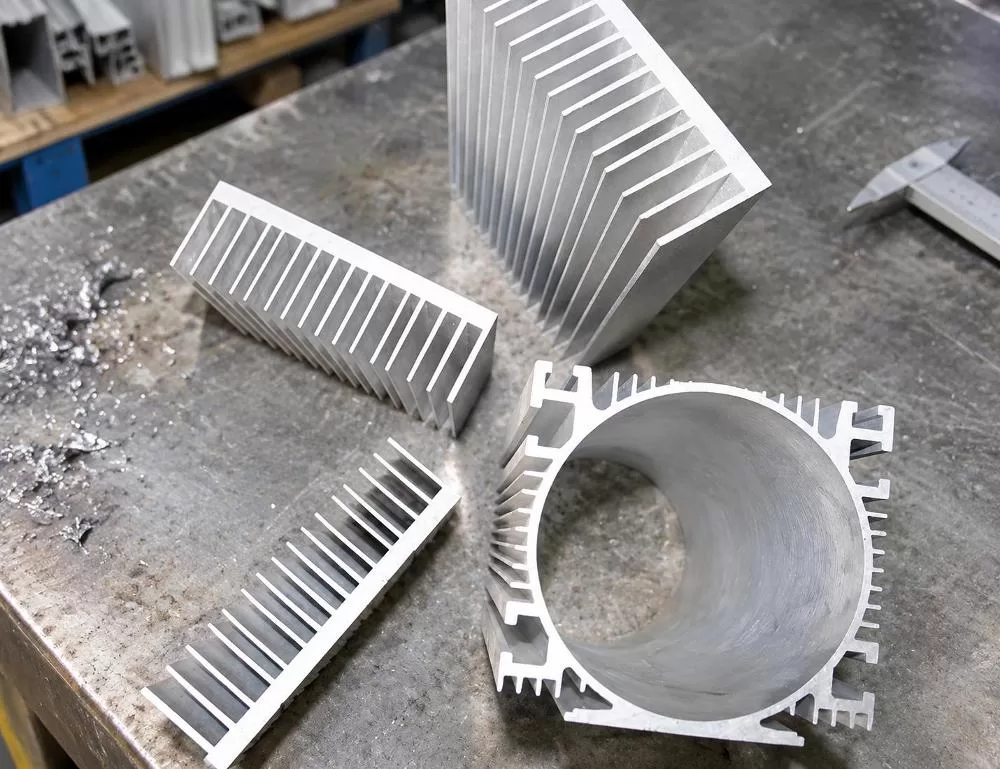
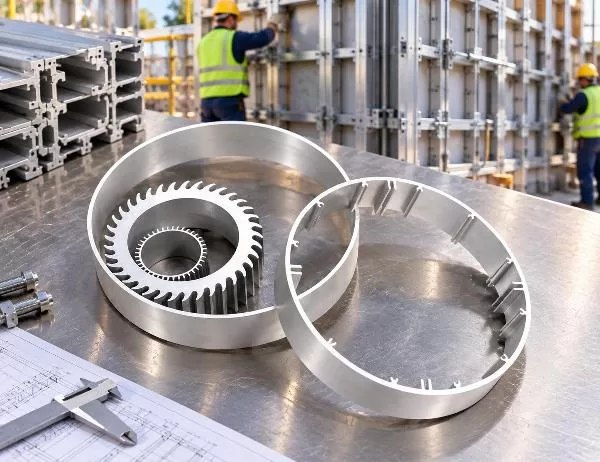
That image above illustrates a point worth dwelling on: cooling fin geometry is not decorative. The spacing and height of each fin on a combed heat sink profile determines how much surface area contacts moving air, which in turn determines how fast heat leaves the component. A profile with tighter, more uniform fins extruded on a high-tonnage press tends to hold tolerance better across a long run than one pushed through underpowered equipment.
Buyers new to aluminium extrusion often treat the spec sheet as a formality. It is not. Three fields deserve closer attention before placing an order.
| Specification | Typical Range | Why It Matters |
|---|---|---|
| Alloy Grade | 6000 Series (e.g., 6063) | Determines strength-to-weight ratio and extrudability |
| Temper | T3 to T8 | Controls hardness and ductility after heat treatment |
| Wall Thickness | Above 0.7mm | Affects structural rigidity and resistance to deformation |
| Profile Length | 1 to 8 meters | Impacts shipping logistics and on-site cutting needs |
Temper designation, specifically, tends to confuse first-time buyers. A T3 temper is softer and easier to bend into custom shapes, while T8 offers higher strength but less flexibility during post-extrusion forming. Choosing the wrong temper for a bending or machining operation downstream can crack the part or waste a production run.
Wall thickness tolerance matters just as much, especially for parts that interlock with other components. Even a small deviation across a long profile length can throw off an entire assembly line that depends on consistent fit.
Surface treatment is where many industrial buyers underinvest, mostly because the profile is hidden inside a machine or enclosure. That reasoning holds up until corrosion or wear becomes a maintenance headache a year later.
Several finishing routes suit different industrial conditions:
None of these finishes change the underlying alloy’s mechanical behavior. They change how the profile ages in its working environment, which is a separate but equally important consideration.
Scale is not vanity metrics. It is a practical signal of what a supplier can actually deliver under deadline pressure. A facility running on a handful of presses struggles with large or urgent orders, while one with broader press capacity can absorb variable demand without pushing lead times out by months.
Consider these capacity indicators when vetting a supplier:
Goldapple-Alu operates across these capacity dimensions, running 24 extrusion presses up to 3600 tons alongside in-house billet casting, which is one reason industrial buyers evaluate us for structural and thermal profile orders.
Does a higher temper always mean a stronger profile?
Generally yes, T8 profiles resist deformation better than T3, but higher temper also reduces how easily the metal can be bent or formed afterward. The right choice depends on whether your part needs post-extrusion shaping.
Can one profile design serve both structural and thermal purposes?
Sometimes, but it is rarely optimal. A profile optimized for heat dissipation prioritizes fin surface area, while a structural profile prioritizes wall thickness and load-bearing geometry. Combining both goals usually means compromising on one.
Why do minimum order quantities matter for sourcing decisions?
MOQs reflect how extrusion lines are scheduled. Running a press for a small custom order is inefficient, so most suppliers set a tonnage floor, commonly around 10 tons, to justify the production run after samples are approved.
Is anodizing better than powder coating for industrial parts?
Neither is universally better. Anodizing offers a harder, thinner oxide layer suited to abrasion resistance, while powder coating provides thicker, more customizable color and durability for visible housings. The right choice depends on exposure conditions.
Choosing among aluminium profile suppliers comes down to matching real production capability to the specific demands of the application, not just comparing unit prices on a quote sheet. A profile destined for a heat sink inside industrial electronics has different priorities than one framing a conveyor system on a factory floor.
Buyers who ask pointed questions about billet sourcing, press tonnage, and certification coverage tend to avoid costly mismatches later. Those details rarely show up on the first page of a catalog, but they explain why two seemingly identical extrusions behave so differently once installed. For industrial projects where structural reliability and thermal performance both carry real consequences, working with experienced aluminium profile suppliers who control their own casting and extrusion process remains one of the more dependable ways to reduce that risk.