Sliding wardrobe doors fail for one of two reasons. Either the track sags under daily use, or the frame reacts badly to humidity and warps at the joints. An aluminium profile for wardrobe construction solves both problems at once, because it combines dimensional stability with a track geometry built specifically for repeated sliding motion. Anyone sourcing cabinetry hardware at scale eventually runs into the same question: what actually separates a durable aluminium frame from one that rattles within a year?
The answer sits in the alloy, the wall thickness, and the way the extrusion is drawn. Wood swells, MDF chips at the edges, and plastic tracks wear down into a groove that throws the rollers off-center. Aluminium does none of that. It holds its shape through seasonal humidity swings, which matters more in wardrobe applications than in almost any other furniture category, since closet doors get touched multiple times a day for years.
A sliding closet door isn’t just a flat panel. It’s a load-bearing assembly that depends on the track holding a precise channel width, year after year, without deforming. If the channel widens even slightly, the door starts to wobble side to side instead of gliding straight.
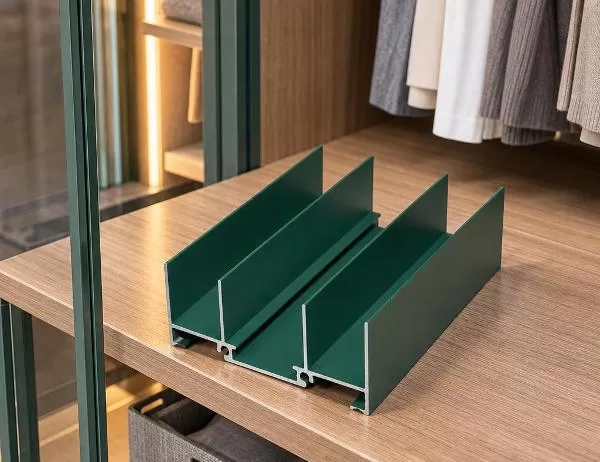
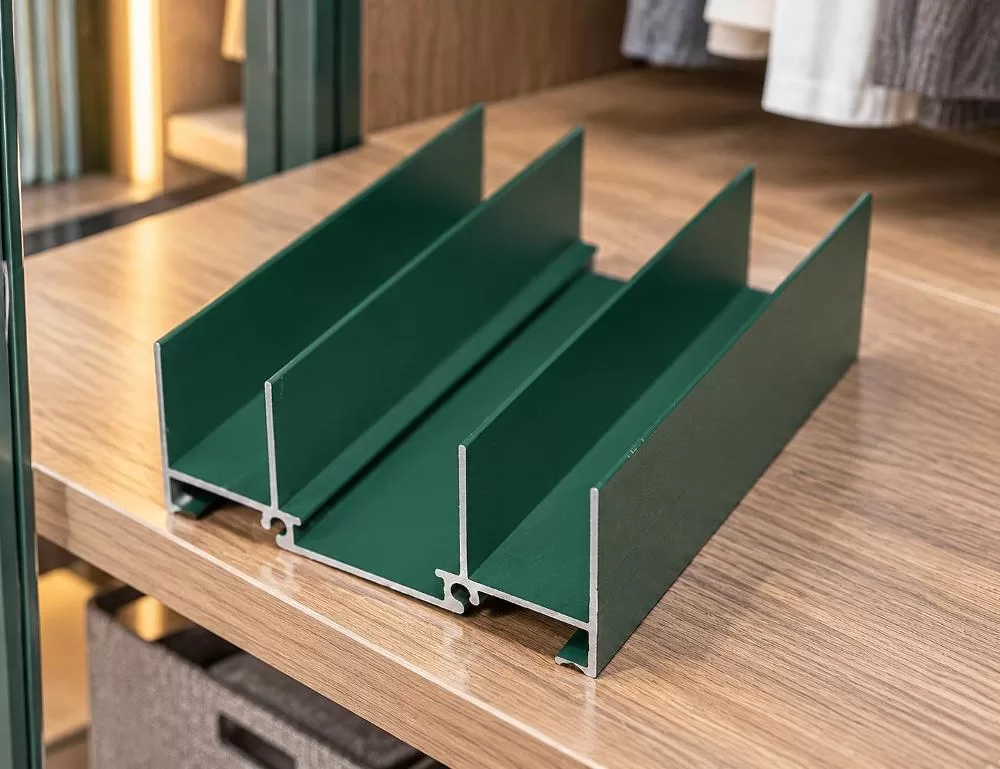
This is why generic aluminium stock, cut from a profile meant for window frames or shelving, often underperforms in closet applications. Wardrobe track extrusions are drawn with dual parallel flanges that form two separate sliding channels plus a bottom interlocking channel for the lower guide. That geometry isn’t decorative. It’s what keeps the rollers tracking in a straight line instead of drifting toward one edge of the channel.
The AE40-6063 profile from our range follows this logic. It’s extruded from 6000-series aluminium alloy in T3 to T8 temper, with wall thickness above 0.7mm, which gives the channel walls enough rigidity to resist the lateral load a heavy mirrored door puts on the track during use.
Not all aluminium is equal, and the alloy series matters more than most buyers realize when they’re comparing suppliers on price alone. 6000-series alloys are the standard choice for architectural and furniture extrusions because they balance strength, machinability, and corrosion resistance without the brittleness you’d get from a higher-strength but less workable alloy family.
The temper designation, T3 through T8 in this case, describes how the metal was heat-treated and aged after extrusion. Lower numbers in that range generally mean more workability, higher numbers mean more hardness and strength. A supplier offering a temper range rather than a single fixed value is usually giving fabricators room to pick the right stiffness for a given door size, since a tall wardrobe panel needs a stiffer frame than a short one.
Here’s where wall thickness comes back into the conversation. A 0.7mm wall sounds thin on paper, but in a properly ribbed extrusion profile, that thickness is distributed across a cross-section engineered for bending resistance, not just raw mass. This is the same principle used in aircraft skin panels: shape carries load more efficiently than bulk.
Finish choice is rarely just an aesthetic decision. It also determines how the profile ages in a given environment and how it reads against the rest of a room’s cabinetry.
| Finish Type | Typical Use Case | Visual Character |
|---|---|---|
| Powder coating | Bedroom wardrobes, color-matched interiors | Matte or satin, wide color range |
| Anodized | Humid climates, minimalist interiors | Hard, uniform metallic sheen |
| Silver polish | Modern or industrial-style closets | Bright, reflective metal look |
| Wood grain transfer | Interiors needing a timber aesthetic without timber | Realistic grain pattern on metal substrate |
| High gloss | Showroom or luxury retail cabinetry | Mirror-like, light-amplifying surface |
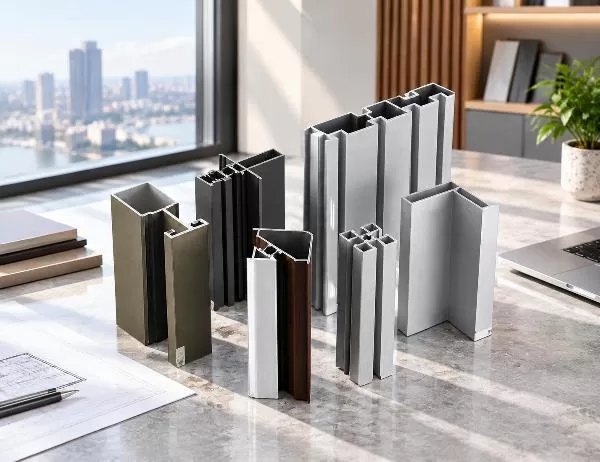
Powder coating remains the most requested option for residential wardrobe frames, largely because it’s available across a wide color spectrum and holds up well against fingerprints and minor scuffs near handles. Wood grain transfer finishes solve a different problem entirely: they let a designer match a wardrobe frame to timber flooring or paneling without introducing an actual wood component that could warp near a humid bathroom-adjacent closet.
Anodizing, by comparison, is less about color variety and more about a hardened oxide layer sitting on the surface. For closets in coastal regions or buildings without climate control, that layer offers a meaningful edge in long-term corrosion resistance.
Sliding doors that squeal or clunk aren’t usually a hardware defect. More often, the track profile and the roller mechanism were never designed together. A pulley wheel that’s slightly oversized for its channel will bind. One that’s undersized will rattle.
The AE40-6063 track structure is built to accommodate carbon fiber ball-bearing pulleys, which distribute the door’s weight across a bearing surface rather than a single contact point. According to the manufacturer’s specifications, this pairing is intended to deliver quiet operation, since ball-bearing rollers reduce the friction spikes that cause the stop-start jerking motion typical of cheaper nylon wheel systems.
There’s also a safety dimension worth flagging for anyone specifying hardware for commercial installations. The profile is engineered to support double anti-jump devices, a mechanical feature that keeps the door panel seated in its channel even if it’s lifted or bumped forcefully, which matters in high-traffic settings like rental apartments or hotel closets where doors see less careful handling.
Formaldehyde emissions from MDF and particleboard furniture have become a bigger regulatory and health concern over the past decade, particularly in enclosed bedroom environments where ventilation is limited. A wardrobe sits inches from where people sleep for roughly a third of their lives, so the material choice isn’t trivial.
Aluminium framing sidesteps the issue structurally rather than chemically. There’s no resin binder, no adhesive layer, and no particleboard core to off-gas over time. That makes an aluminium frame profile a straightforward way to reduce one source of indoor air contaminants without relying on low-VOC coatings or sealants that only mask the problem temporarily.
For buyers furnishing nurseries, healthcare facilities, or any space where air quality is scrutinized, this is often the deciding factor over price per meter.
Extrusion length and minimum order quantity shape how a profile fits into a project timeline, especially for buyers unfamiliar with how aluminium is typically sold at the manufacturing level.
Fabricators managing multiple residential projects often batch their aluminium orders across several wardrobe designs at once specifically to meet that tonnage threshold efficiently.
Does aluminium framing cost more than a wood or PVC wardrobe frame?
Per linear meter, aluminium often sits above basic PVC and comparable to mid-range wood framing. The cost difference tends to even out over the product’s lifespan, since aluminium doesn’t need refinishing or replacement due to warping.
Can an aluminium wardrobe frame be repainted later?
Powder-coated and wet-painted finishes can typically be recoated by a professional, though anodized surfaces are harder to alter once applied, since the color sits within an oxide layer rather than on top of the metal.
Is a thicker wall always better for wardrobe track profiles?
Not necessarily. Wall thickness has to match the door’s weight and height. Over-specifying thickness adds cost and weight without a proportional gain in performance for a standard-sized closet door.
Will the track rust in a bathroom-adjacent closet?
Aluminium doesn’t rust in the way steel does, since it forms a natural oxide layer that resists corrosion. Anodized finishes extend that resistance further in consistently humid conditions.
Choosing an aluminium profile for wardrobe systems ultimately comes down to matching three variables: the alloy and temper to the expected load, the finish to the room’s design language, and the order volume to the realistic scale of the project. Skipping any one of those steps tends to show up later as a sticking door, a mismatched finish, or a procurement bottleneck mid-build.
For manufacturers and fabricators sourcing at volume, working with a supplier that documents alloy grade, temper range, and third-party inspection support, as Goldapple-Alu does across its extrusion lines, removes much of the guesswork from that decision. A well-specified aluminium frame profile for wardrobe doors isn’t the most glamorous line item in a furniture project, but it’s often the one that determines whether the finished cabinetry still glides quietly five years after installation.