Finding the right aluminum heat sink manufacturers often decides whether a motor housing survives five years or fails after one summer of heavy load. Thermal management is not an afterthought anymore. It is a design constraint that shapes material choice, extrusion profile, and surface treatment from day one. This guide walks through what actually matters when sourcing extruded aluminum heatsinks for industrial equipment, so the decision rests on engineering logic rather than a glossy datasheet.
Every electric motor, inverter, and compressor generates heat as a byproduct of doing work. Left unmanaged, that heat accelerates insulation breakdown and bearing wear. A housing that cannot shed thermal load becomes the weakest link in an otherwise well-engineered machine.
Aluminum earns its place here through sheer physics. It conducts heat roughly four times faster than steel, while weighing about a third as much. For motor shells and compressor units that need to stay light yet thermally stable, that ratio is hard to beat with any other common structural metal.
Not all aluminum shapes dissipate heat equally. The real variable is surface area, not just material. A smooth cylindrical shell loses heat slowly; a finned profile with radial projections exposes far more surface to moving air, letting convection do the heavy lifting.
This is why radial heatsink fins show up so often in motor housings and electronic enclosures. Each fin acts like a small radiator, and the deeper the fin channel, the more air can pass between them without turbulence choking the flow. Engineers sometimes call this the fin-to-air contact ratio, though in practice it is just a function of fin count, height, and spacing.
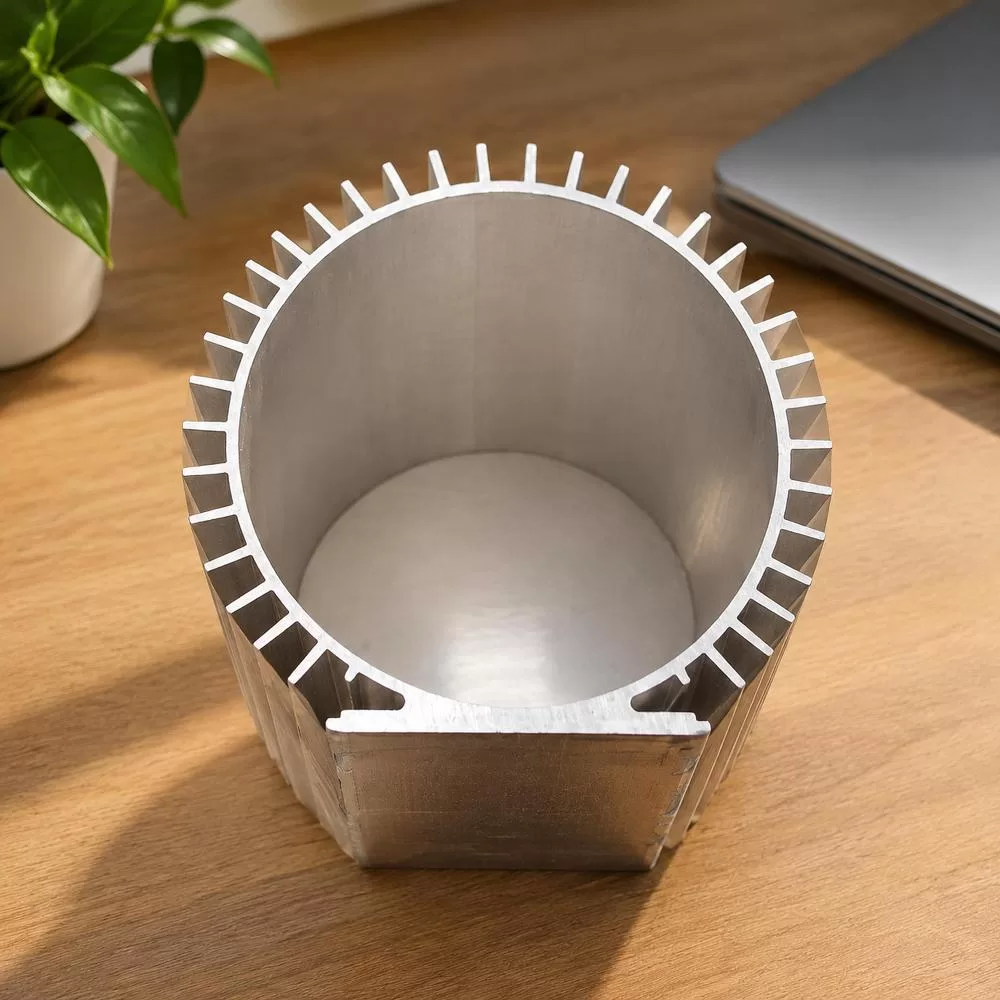
The cross-section above shows a typical radial fin arrangement with a flat mounting base. That base matters as much as the fins themselves, since it determines how evenly heat transfers from the motor core into the extrusion before the fins ever get a chance to release it.
Aluminum alloy choice is not cosmetic. The 6000 series, particularly 6063 and 6061 grades, strikes a balance between extrudability and mechanical strength that pure aluminum or 7000 series alloys struggle to match for this application.
A few reasons 6000 series shows up repeatedly in heatsink production:
Pure aluminum conducts heat slightly better in theory, but it lacks the structural integrity to survive mounting bolts, vibration, and years of thermal cycling. The alloy trade-off almost always favors 6000 series for anything load-bearing.
Raw aluminum oxidizes on contact with air, forming a thin protective layer naturally. But that layer is fragile and uneven. Anodizing thickens and controls this oxide layer electrochemically, turning a weak natural defense into a durable engineered one.
Silver anodized finishes, specifically, serve two practical purposes beyond appearance. First, the anodized layer resists pitting and galvanic corrosion in humid or chemically exposed settings like coastal wind farms or chemical processing plants. Second, it reduces maintenance frequency, since the surface no longer needs repainting or recoating every few years.
For equipment destined for outdoor installation, such as wind power generation units or railway locomotive components, skipping anodizing is a false economy. The upfront cost difference is small compared to the downtime cost of corrosion-driven failure five years later.
Thickness and length are not arbitrary spec sheet numbers. They directly affect how much heat a profile can carry away and how it behaves under mechanical stress.
| Specification | Typical Range | Why It Matters |
|---|---|---|
| Thickness | Above 0.7mm | Thinner walls save weight but limit heat capacity and structural rigidity |
| Length | 1 to 8 meters | Longer runs reduce joint count but require tighter straightness tolerance |
| Temper | T3 to T8 | Higher temper numbers generally mean greater hardness, slightly lower conductivity |
| Alloy Grade | 6000 Series | Balances extrudability, strength, and thermal performance |
Thinner sections work fine for lightweight household appliances. Industrial machinery and automotive housings, on the other hand, usually need thicker walls to survive vibration and repeated thermal cycling without fatigue cracking at the fin roots.
A heatsink extrusion rarely leaves the factory in its raw form. Most projects require CNC machining for mounting holes, sawing to exact length, drilling for cable routing, or additional finishing steps before the part fits into a final assembly.
This is where sourcing decisions get practical rather than theoretical. A supplier offering fabrication-ready profiles, meaning extrusions that accept secondary machining without cracking or warping, saves downstream manufacturers from costly rework. If a profile’s temper is too soft, drilling can deform the fin structure. Too hard, and CNC tooling wears out faster than expected.
Choosing a supplier is less about finding the lowest quote and more about matching production capability to the application’s real demands. A few checkpoints help narrow the field:
Skipping these steps often leads to mismatched expectations later, particularly around tolerances that look fine on paper but cause fit issues during assembly.
Heatsink extrusions built on this design logic show up across a surprisingly wide range of industrial equipment, not just motors. Typical applications include:
The common thread across all of these is a need to move heat away from a compact, often sealed, enclosure without adding significant weight or ongoing maintenance burden.
Does a higher fin count always mean better cooling?
Not necessarily. Beyond a certain density, fins start restricting airflow between them, which can trap heat instead of releasing it. Fin spacing has to match the airflow source, whether that’s natural convection or forced air from a fan.
Is anodized aluminum the same as painted aluminum for corrosion protection?
No. Anodizing creates a chemically bonded oxide layer within the metal’s surface, while paint sits on top as a separate coating that can chip or peel. Anodized finishes generally hold up longer in abrasive or humid environments.
Can these extrusions be welded during assembly?
6000 series aluminum can be welded, though welding locally affects temper and strength near the joint. Mechanical fastening or adhesive bonding is often preferred when the original temper properties need to stay intact.
Why does minimum order quantity matter for extrusion profiles?
Extrusion dies and production runs have setup costs that only make sense at volume. Smaller buyers sometimes need to work with distributors holding stock rather than ordering direct from a mill.
Picking a heatsink profile is ultimately an exercise in matching alloy, geometry, and surface treatment to the thermal and mechanical demands of a specific application. None of these variables works in isolation. A perfectly finned profile in the wrong alloy will underperform, just as a strong alloy with poor fin design will fail to dissipate heat fast enough.
For buyers comparing aluminum heat sink manufacturers, the practical test is whether a supplier can explain these trade-offs clearly rather than just quoting a price per kilogram. We work from a 530,000㎡ production base with updated extrusion and surface treatment lines, covering silver anodized heatsink profiles alongside broader aluminum extrusion capabilities for door, window, curtain wall, and industrial applications. That breadth matters when a single project needs both a structural profile and a thermally engineered one from the same production line, since consistent alloy sourcing and quality control across both reduces the risk of mismatched batches down the line.